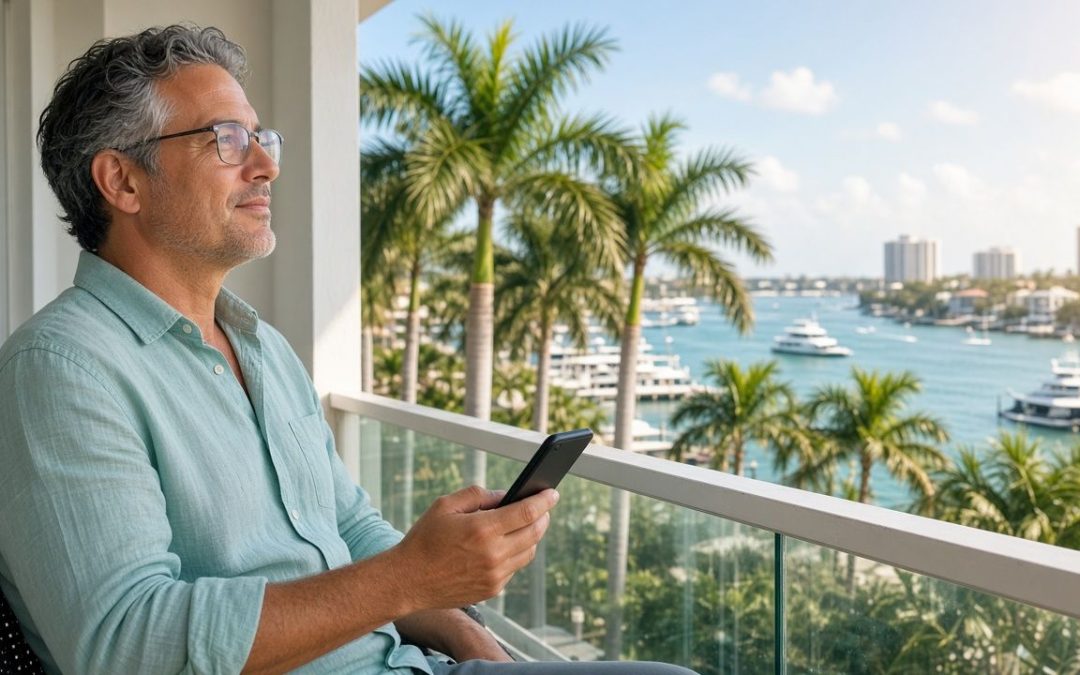
If you have started holding your phone at arm’s length, taking your glasses off to read a menu, or switching between two pairs of glasses all day, you are not alone. Most adults notice changes in their near vision sometime in their 40s. Progressive lenses are one of the most popular ways to see clearly at every distance with a single pair of glasses. At Fort Lauderdale Eye Care and Eyewear, our optometrists and opticians help patients in Fort Lauderdale find progressive lenses that fit their eyes, their frames and the way they live.
Why Near Vision Changes After 40
Inside your eye, a flexible natural lens changes shape to focus on things up close. With age, that lens slowly becomes less flexible, so focusing on small print gets harder. This normal change is called presbyopia. It happens to nearly everyone, including people who have never needed glasses before, and it tends to keep changing gradually over the years.
Common signs of presbyopia include:
- Holding books, menus or your phone farther away to read them
- Needing brighter light for reading
- Eye strain, tired eyes or headaches after close work
- Blurry near vision when you are wearing your distance glasses or contacts
Because these symptoms can overlap with other eye conditions, it is a good idea to have a comprehensive eye exam rather than guessing with store-bought readers.
What Are Progressive Lenses?
Progressive lenses are multifocal eyeglass lenses that give you clear vision far away, at middle distance and up close, all in one lens. The prescription changes smoothly from the top of the lens to the bottom:
- Top: distance vision for driving, watching TV and seeing across the room
- Middle: intermediate vision for computer screens, your car dashboard and conversations across a table
- Bottom: near vision for reading, your phone and detailed close work
Unlike traditional bifocals or trifocals, progressive lenses have no visible lines. That means a cleaner, more youthful look and no sudden “jump” in the image as your eyes move from one zone to the next.
Progressives vs. Bifocals vs. Readers
Reading glasses only help up close, so you have to take them off or look over them to see across the room. Bifocals have two zones separated by a visible line, usually distance on top and near on the bottom, with no dedicated area for the computer. Progressive lenses blend all three distances together without lines, which is why many people who use screens, drive and read throughout the day prefer them.
Some people also benefit from a second pair designed for a specific task, such as computer or office lenses for long hours at a desk. Your optometrist and optician can talk through what makes sense for your daily routine.
Why Custom Progressive Lenses Make a Difference
Not all progressive lenses are the same. Basic designs use a one-size-fits-all layout, which can mean narrower clear zones and more soft blur toward the sides of the lens. Custom, digitally designed progressives are made around your prescription and measurements, which can provide wider, more comfortable viewing areas and an easier adjustment.
At Fort Lauderdale Eye Care and Eyewear, we specialize in custom progressive lenses from Varilux and Hoya, two of the most respected names in lens design. To get the most from a custom lens, our opticians take careful measurements, including:
- Pupil distance and the height of your pupils in your chosen frame
- How the frame sits on your face, including its tilt and wrap
- The distance between your eyes and the lenses
These details help place each vision zone exactly where your eyes naturally look. Our local lab produces lenses with fast turnaround, and having a local lab means any fine-tuning can be handled quickly and carefully.
Lens Options That Pair Well With Progressives
Progressive lenses can be combined with other lens features to make them even more useful in South Florida:
- Crizal anti-reflective coatings reduce glare from headlights, screens and overhead lights, help lenses resist smudges and scratches, and make your lenses look clearer to others.
- Transitions light-adaptive lenses are clear indoors and darken automatically in sunlight, so one pair can work inside and out.
- Prescription sunglasses with progressive lenses let you read your phone, see the road and enjoy the beach in comfort. Browse our sunglasses for styles that work well with progressives.
Choosing the Right Frame
Frame choice matters with progressives. The frame needs enough lens height to fit the distance, intermediate and reading zones comfortably. Our opticians can help you find a frame you love that also gives your progressive lenses room to work. Explore our selection of designer eyeglasses, then let us help you narrow it down in person.
Tips for Adjusting to New Progressive Lenses
Most people adapt to progressive lenses comfortably, especially with a custom design and an accurate fitting. A few tips can help:
- Wear your new glasses full time at first instead of switching back and forth with old pairs.
- Point your nose toward what you want to see, and turn your head rather than just your eyes.
- Lower your eyes, not your head, to read through the bottom of the lens.
- Take extra care on stairs and curbs during the first days while you get used to them.
- If something still feels off, come back. A small frame adjustment often makes a big difference.
Frequently Asked Questions
At what age do people usually need progressive lenses?
Many people start noticing near vision changes in their 40s, but everyone is different. An eye exam is the best way to know whether progressives are right for you.
Can I wear progressive lenses if I have never worn glasses?
Yes. Progressive lenses can be made even if you only need help up close. In that case the top of the lens may have little or no prescription.
Are progressive lenses covered by vision insurance?
Coverage depends on your specific plan. Many vision plans include some benefit toward lenses and lens options. Visit our insurance information page or contact our office and we will help you understand your benefits.
Can I get progressive lenses in sunglasses?
Yes. Progressive lenses can be made in prescription sunglasses, and Transitions lenses are another option if you want one pair that darkens outdoors.
Do progressive lenses work for computer use?
The middle zone of a progressive lens is designed for intermediate distances like a computer screen. If you spend long hours at a desk, ask us about computer or office lenses as a second pair.
See Clearly at Every Distance in Fort Lauderdale
If you are juggling readers, struggling with small print or ready to upgrade from bifocals, custom progressive lenses may be the answer. The team at Fort Lauderdale Eye Care and Eyewear will check your vision, help you choose a frame and fit you with custom Varilux or Hoya progressive lenses made by our local lab.
Call or Text 954-763-2842 or request an appointment online today.